All posts on this blog are written by a commercial airline pilot actively flying in South Korea. AI tools are used only for grammar and spelling review before publishing.
Every time an aviation accident makes the news, the same phrase appears within hours: investigators are searching for the black boxes. And every time, a significant portion of the public imagines something roughly the size of a shoebox, painted black, containing a single mysterious recording device hidden somewhere in the wreckage.
Almost none of that is accurate.
I am a commercial airline pilot. Every aircraft I fly carries two flight recorders. I know roughly where they are, I know what they are capturing at this exact moment during any flight I operate, and I know that in the event of an accident, the information on those devices would likely be the most important evidence available to investigators.
Here is what is actually inside the black box — and why the name itself is one of aviation's most persistent misconceptions.

It Is Not One Box — It Is Two
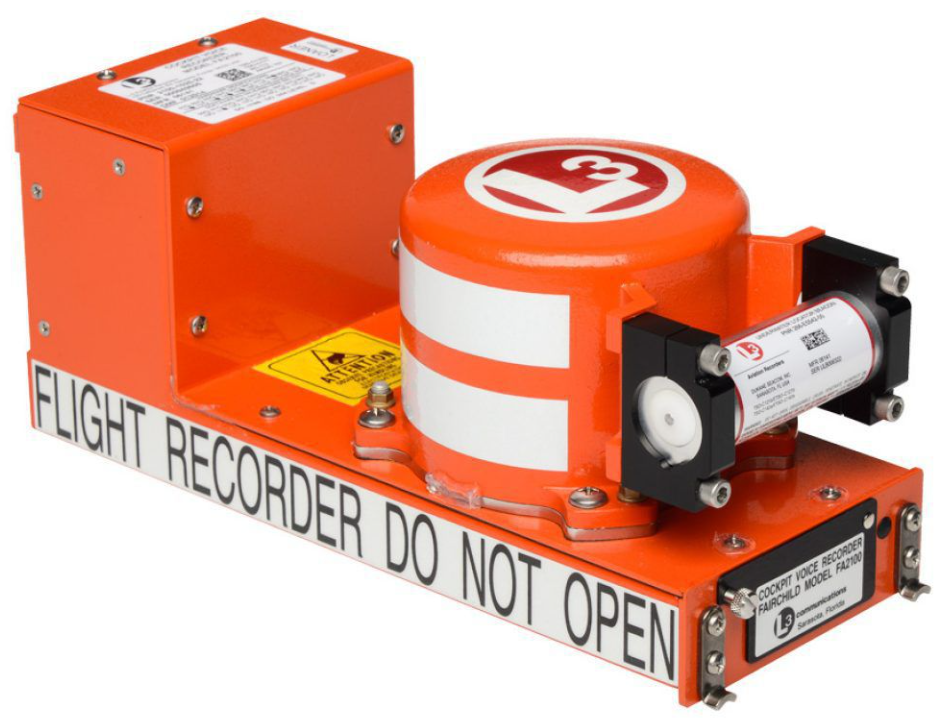
What most people call "the black box" is actually two separate devices: the Flight Data Recorder (FDR), which captures technical parameters, and the Cockpit Voice Recorder (CVR), which records audio from the flight deck.
These two devices serve completely different purposes and capture completely different types of information. They are physically separate units, installed in different locations on the aircraft, and read by investigators using different equipment. The only things they have in common are their bright orange casings, their location in the tail section of the aircraft, and their purpose: to survive an accident and tell investigators what happened.
Together, they give investigators two parallel accounts of the same flight — the objective data of what the aircraft was doing, and the human account of what the crew was saying and doing. Neither is complete without the other.
Why It Is Called "Black" When It Is Orange
Contrary to what many people assume, flight recorders are not black at all. They are painted bright orange — sometimes yellow — and covered with reflective tape. This is to increase the chances of finding them among the wreckage of a crashed airplane.
The origin of the name "black box" is debated. Some aviation historians believe it comes from early recording devices that were literally painted black to reduce reflections. Others suggest it was originally a British Royal Air Force term for any secret or proprietary piece of equipment — a "black box" being something whose internal workings were unknown to the user.
Whatever the origin, the name stuck long after the devices stopped being black. Today, an experienced crash investigator walking toward wreckage looks for bright orange, not black. The entire point is maximum visibility.
The Flight Data Recorder: What the Aircraft Is Doing
The Flight Data Recorder captures technical parameters — at least 88 different measurements on older aircraft, including altitude, airspeed, heading, engine power settings, and control surface positions.Modern aircraft like the Boeing 787 and Airbus A350 record over 2,000 parameters, providing unprecedented detail for incident analysis.
Every sensor on the aircraft feeds into this system. At any given moment during one of my flights, the FDR is capturing data about every major system simultaneously.
Modern FDRs sample some parameters multiple times per second, building a precise digital picture of the aircraft state throughout the flight.
When investigators recover an FDR after an accident, they can reconstruct an extraordinarily detailed picture of exactly what the aircraft was doing — down to which circuit breakers were open, what position each control surface was in, and what the engine power output was at every second of the flight.
The FDR retains the last 25 hours of flight data.
It continuously overwrites its oldest material. This means investigators always have the full record of a flight, but older flights from the same aircraft are eventually lost — a deliberate design choice.
The FDR is not just used in accidents.
Flight Data Monitoring (FDM) programs use FDR data proactively — airlines routinely download and analyze the data to identify trends, catch developing problems before they become serious, and evaluate crew technique.
Every unusual parameter exceedance, every hard landing, every go-around gets recorded and reviewed. This is one of the less visible but most important contributions of flight recorders to aviation safety.
The Cockpit Voice Recorder: What We Are Saying
The Cockpit Voice Recorder captures all radio communications, as well as ambient sounds, through a central microphone and through each crew member's headset.
This means the CVR captures everything audible in the cockpit: conversations between pilots, radio calls to air traffic control, automated system alerts and warnings, engine sounds, the sound of flaps extending, the click of switches being thrown.
A change in engine tone might indicate a power change or a malfunction. CVR transcripts are painstakingly detailed documents, and their preparation can take weeks.The CVR continuously records in a loop and overwrites the oldest audio once it reaches its retention limit. Standard requirement has been 2 hours, but current regulations now require 25-hour recording for aircraft manufactured from 2026 onward.
The CVR fills in what the FDR cannot tell. The FDR might show an aircraft descending rapidly with engines at idle power. But only the CVR tells investigators whether the pilots were calmly executing an emergency checklist, shouting in confusion, or silent — each of which would suggest very different accident scenarios.
A notable example is American Airlines Flight 587, where FDR data conclusively showed the cause was pilot-induced rudder inputs, helping prevent nationwide panic about terrorism following the 9/11 attacks. The clear evidence from the FDR helped investigators reach factual conclusions quickly.
What It Feels Like Knowing You Are Always Being Recorded
This is the question I get asked most often when people find out about the CVR.
The honest answer is: you stop noticing it after the first few weeks. It becomes background to the work, the same way a surgeon stops being self-conscious about the operating room cameras that record procedures for training purposes.
The CVR captures everything. Banter between the crew during cruise. Discussions about where to eat in the layover city. Frustration when ATC gives us a long routing. Everything.
There is a protocol that protects crew privacy. CVR recordings are not routinely accessed — they are only reviewed after an incident or accident that meets specific criteria. The audio has legal protections in most jurisdictions, and investigators who listen to CVR recordings are bound by strict confidentiality requirements. The goal is accident investigation, not surveillance.
Some CVR installations provide an erase function that operates only on the ground when specified safety conditions are met — the aircraft must be on the ground with the engines shut down.
Pilots can erase the CVR at the end of a flight in some aircraft types, which addresses some of the privacy concerns. Whether they should be allowed to do so has been debated extensively in aviation safety circles.
What the recording does change, subtly and permanently, is how seriously I take the responsibility of professional cockpit communication. Everything said on my flight deck could one day be the subject of an official investigation. That awareness reinforces discipline in a way that periodic checks alone never quite could.
How It Survives a Crash
The engineering behind crash protection is genuinely remarkable.
Flight recorders are designed to survive the most extreme conditions an aircraft accident can produce. The memory unit — the component that actually stores the data — is encased in multiple protective layers. The outer shell is made of stainless steel or titanium. Inside that is a layer of high-temperature insulation. Inside that is the crash-protected memory unit itself.
The survival specifications required by regulators include:
- Impact: must survive a 3,400G deceleration force — equivalent to hitting a wall at hundreds of kilometres per hour
- Fire: must survive 1,100°C (2,012°F) for one hour — the temperature of a jet fuel fire
- Pressure: must survive being crushed under 5,000 pounds per square inch
- Water: must survive submersion at 20,000 feet underwater for 30 days
- Underwater locator: equipped with an Underwater Locator Beacon (ULB) that activates automatically on water contact and pings for at least 30 days
This combination of protections is why flight recorders are recoverable in accidents that destroy everything else on the aircraft. The memory chips themselves are essentially buried inside a structure designed to absorb and dissipate forces that would obliterate the surrounding fuselage.
Where on the Aircraft Are They?
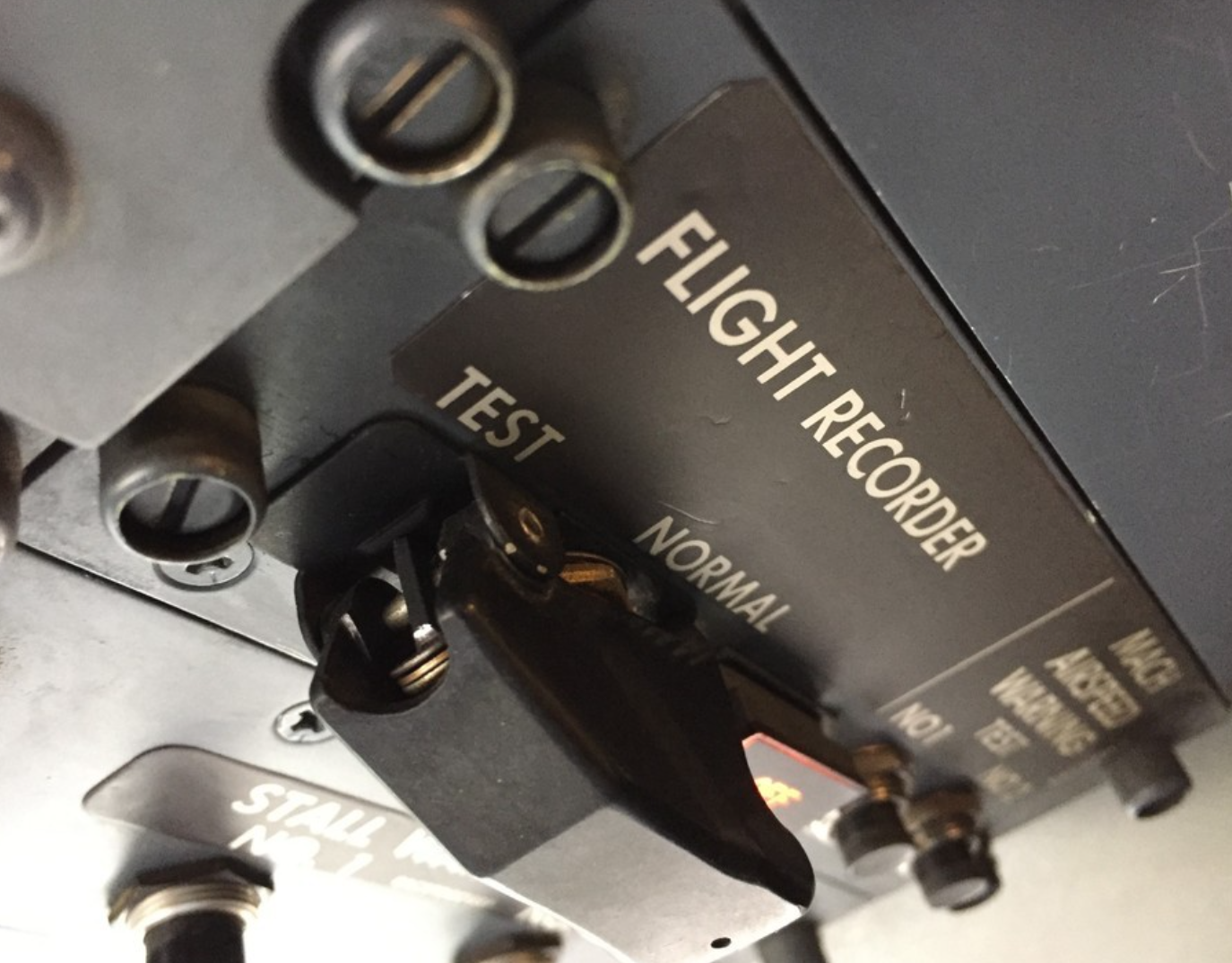
Both recorders are installed in the tail section of the aircraft — specifically in the aft fuselage, near the rear pressure bulkhead.
This location is not accidental. Statistical analysis of aviation accidents shows that the tail section is the part of the aircraft most likely to remain relatively intact in a crash, particularly in impact-with-terrain accidents where the nose absorbs the initial force. Placing the recorders as far back in the aircraft as possible maximizes the probability that they survive the accident sequence.
The recorders are also located near the outside of the fuselage to make them easier to access for investigators without requiring them to excavate through the entire wreckage. In many accidents, the recorders can be extracted from the outside of the fuselage shell without entering the main cabin.
How Investigators Find and Read Them
Once recovered, the recorder is sent to a specialized laboratory — the NTSB in Washington DC, the BEA in Paris, or the AAIB in the UK, depending on jurisdiction.
The read process follows a careful sequence:
- Physical inspection: assess damage, clean connections, determine the safest read strategy
- Data extraction: connect to specialized interface equipment and download the raw memory
- Decoding: convert raw binary data into engineering units using aircraft-specific parameter documentation
- Reconstruction: use flight simulator software to animate the flight path and aircraft state
- CVR transcription: create a time-synchronized transcript of all cockpit audio
- Correlation: align FDR data with CVR transcript, radar data, and ATC recordings to build a complete picture
Even severely damaged recorders can often yield data. Investigators have extracted usable information from recorders that were burned, crushed, or submerged in seawater for extended periods. The memory chips are the most protected component, and as long as they are physically intact, the data is usually recoverable.
New 2026 Rules: 25-Hour Recording Requirement
Regulations now require 25-hour recording duration for aircraft manufactured from 2026 onward, extended from the previous 2-hour CVR standard.
This change addresses a long-standing gap. Accidents sometimes involve events that began hours before the final sequence — a developing mechanical problem, a series of crew decisions, a building fatigue factor. A 2-hour CVR only captured the end of the story. The 25-hour requirement means investigators will now have access to the full context of a flight, including everything that happened on the previous leg.
The extended duration raises privacy concerns that aviation authorities are still working through. A 25-hour recording captures far more casual conversation than a 2-hour one. How that data is protected, when it can be accessed, and who can listen to it are questions that different jurisdictions are answering differently.
The Inventor Nobody Listened To
The flight recorder concept was pioneered by David Warren, an Australian research scientist at the Aeronautical Research Laboratories in Melbourne. Warren built the first combined voice and flight data recorder in 1957. His invention was initially rejected by Australian aviation authorities — they saw no need for it.
Warren had personal motivation. His father died in one of Australia's earliest airline accidents, and Warren became convinced that a device capable of recording what happened in the cockpit before an accident would transform the ability to understand — and prevent — future crashes.
Australian authorities rejected his prototype. Warren eventually demonstrated it to a British air safety official who was visiting Australia. The British took it seriously. Within a few years, the UK mandated flight recorders on its commercial aircraft. Other countries followed. Australia — the country that had initially rejected the invention — eventually made them mandatory too.
David Warren died in 2010, having lived to see his invention become the global standard it is today, installed on every commercial aircraft on earth. The device that nobody wanted is now the first thing every accident investigation team searches for.
Final Note from the Flight Deck
Every flight I operate, two orange boxes at the back of my aircraft are quietly recording everything. The altitude, the airspeed, the engine output, the position of every control surface. My voice. My co-pilot's voice. Every alarm. Every radio call.
Most of that data will never be seen by anyone outside the airline's flight data monitoring program. It will be overwritten by the next flight, and the flight after that.
But it is there. And knowing it is there — knowing that my work is documented in extraordinary detail — is one of several layers that make commercial aviation as safe as it is. Accountability is built into the aircraft itself.
I find that reassuring rather than uncomfortable. And I think, if you understand what those orange boxes actually do, you might too.
This post reflects the author's experience as a commercial airline pilot and publicly available information on flight recorder regulations and technology. Specifications cited reflect ICAO, FAA, and EASA requirements as of mid-2026 and are subject to update.


